4 Playing catch-up
The attacker of Section 2.2 finds himself, at the moment the merchant ships, some number of blocks behind the public chain, and wins if his branch ever overtakes it. This section computes the probability of that event as a function of the deficit; the next section supplies the distribution of the deficit itself.
Both computations run under the paper’s two standing assumptions, stated here nearly verbatim (the environment form is ours, Remark 1.1):
Assumption 4.1 (Constant hashrates).
The total hashrate of the honest network and the attacker is constant. Combined they have a hashrate of , of which belongs to the honest network and to the attacker, where and .
Assumption 4.2 (Constant difficulty).
The mining difficulty is constant, and such that with hashrate the average time to find a block is .
Under Assumption 4.2 every block carries equal work, so “most work” and “longest” coincide and the race can be scored in block counts. Section 8.2 explains how the deployed chain departs from these assumptions — difficulty adjusts after every block and hashrate drifts — and why the formulas should be read as an equal-difficulty baseline rather than an exact deployment model.
Definition 4.3 (The deficit walk).
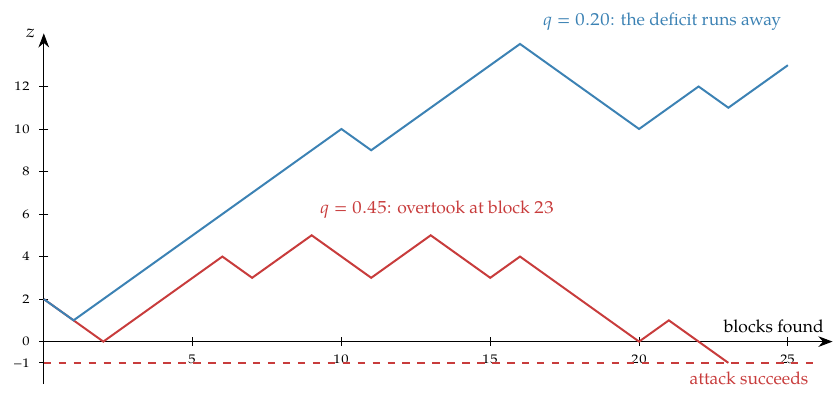
Let denote the honest chain’s lead in blocks over the attacker’s branch. By Proposition 3.4, each newly found block moves up by with probability (honest block) or down by with probability (attacker block), independently of the past:
The attack succeeds the moment reaches : the secret branch is then strictly ahead, and releasing it rewrites history.
Theorem 4.4 (Catch-up probability; Rosenfeld §3).
Let be the probability that the walk of Definition 4.3, started at deficit , ever reaches . Then
| (1) |
Proof.
For the walk has already succeeded, so ; assume . Fix an integer and absorb the walk at both and ; let be the probability of reaching before . Conditioning on the first step,
a second-order linear recurrence. The trial solution satisfies it exactly when is a root of the characteristic polynomial .
If the roots and are distinct, so ; the boundary conditions give
If the root is double and , giving .
Now let . The events are nondecreasing in , and their union is the event that the walk ever reaches : a walk that does so does it at a finite time, having visited finitely many states, so holds for every above the largest state visited. By continuity along monotone events (Math Guide, §“Beyond finite spaces: countable additivity, limits, and densities”), . For the term vanishes and the quotient tends to ; for , ; for , dividing numerator and denominator by sends both to , so the quotient tends to . □
Corollary 4.5 (Half or more always catches up).
When , the attacker overtakes the public chain with probability from any finite deficit. No confirmation count defends when the attacker controls at least half of the hashrate.
Corollary 4.6 (Geometric decay in the deficit).
When , each additional block of deficit multiplies the catch-up probability by . Concretely (script-computed): at , and ; at , and .