6 Symmetric encryption, AEAD, and key derivation
This section defines symmetric encryption, message authentication codes, authenticated encryption with associated data (AEAD), and key-derivation functions, each with its security notion. It proves that encrypt-then-MAC composes a cipher secure against chosen-plaintext attack and a strongly unforgeable MAC with independent keys into an AEAD (Theorem 6.16), and that ChaCha20-Poly1305, the AEAD of Zcash note encryption, is secure for a uniform key and non-repeating nonces if ChaCha20 is a pseudorandom function (Theorem 6.20); a key-derivation function derives that key from a Diffie–Hellman shared secret. The adversary controls the channel: it sees every ciphertext, and may modify, splice, or replay ciphertexts in transit.
Throughout, an adversary is a probabilistic algorithm
A ; the notation
The one-time pad and EAV security.
The information-theoretic baseline is the one-time pad: to
encrypt
6.1 Stream ciphers and ChaCha20
A stream cipher is the practical instantiation of the pseudo-one-time pad: a keyed, seekable generator producing a keystream that XORs into the plaintext. To encrypt many messages under one key without violating the one-time-pad no-reuse rule, modern stream ciphers take an additional public input called a nonce (number used once) and behave like a pseudorandom function of the nonce, in the sense of Section 5.
Definition 6.1 (Nonce-based stream cipher).
A nonce-based stream cipher is a deterministic function
| KS : K × N × N → { 0, 1 } ∗ |
producing, for key k , nonce ν , and length L , a keystream
The stream cipher Zcash deploys—inside the AEAD of §6.5, in the note-encryption layer—is ChaCha20, designed by Bernstein and standardised in RFC 8439. Its core is a reversible mixing of four 32 -bit words built only from modular addition, XOR, and rotation (an “ARX” design), which avoids data-dependent table lookups and hence the timing side channels that table-based ciphers must otherwise mitigate.
Construction 6.2 (ChaCha20).
The ChaCha20 state is a
| a | + = b ; | d | ⊕ = a ; | d | ⋘ = 16 ; | ||
| c | + = d ; | b | ⊕ = c ; | b | ⋘ = 12 ; | ||
| a | + = b ; | d | ⊕ = a ; | d | ⋘ = 8 ; | ||
| c | + = d ; | b | ⊕ = c ; | b | ⋘ = 7 . |
The state is initialised from the 128 -bit constant
“expand 32-byte k” (words x 0 – x 3 ), a
256 -bit key ( x 4 – x 11 ), a 32 -bit block counter
( x 12 ), and a 96 -bit nonce ( x 13 – x 15 ). One
double round applies QR to the four columns and
then to the four diagonals; the 20 rounds of ChaCha20
are ten double rounds. Writing X for the initial state and
R (X) for the state after the rounds, the 64 -byte keystream
block is the feed-forward sum
Remark 6.3 (Feed-forward and counter mode).
The rounds R form a bijection—each quarter-round is invertible,
being a composition of invertible word operations—so without the
final addition the block function would be an invertible permutation,
and an adversary holding a keystream block could run the rounds
backwards. The feed-forward sum
6.2 Chosen-plaintext security
Security against chosen-plaintext attack (CPA) extends EAV security to an adversary that influences which messages are encrypted—by triggering payments, injecting plaintext into a session, or guessing—and observes many ciphertexts. It is modelled by oracle access to the encryption algorithm in the game template of Definition 1.15.
Definition 6.4 (CPA security).
For a symmetric encryption scheme Π with key generator
Gen , adversary A , and bit
-
1.
The challenger samples
k ← Gen (1 λ) and gives A oracle access to Enc k (⋅) . -
2.
At some point A submits a challenge pair (m 0, m 1) of equal-length messages and receives
c ⋆ ← Enc k (m b) . -
3.
The adversary may continue querying the oracle and finally outputs a bit b ′ , which is the output of the game.
The scheme Π is CPA-secure if for every PPT A ,
| Adv Π cpa (A, λ) : = | Pr [CPA Π A (λ, 0) = 1] − Pr [CPA Π A (λ, 1) = 1] | ∈ negl (λ) . |
Proposition 6.5 (Determinism precludes CPA security).
No scheme whose Enc is deterministic and stateless is CPA-secure.
Proof.
The adversary queries the oracle on two distinct messages
A CPA-secure scheme must therefore be randomised or nonce-based. A nonce-based stream cipher used with a fresh nonce per encryption—random, or drawn from a counter—attains CPA security under the PRF conjecture for its keystream generator, because each encryption is then effectively a fresh one-time pad; for ChaCha20 the argument is the confidentiality part of the proof of Theorem 6.20.
Remark 6.6 (Semantic security).
Goldwasser and Micali’s original notion, semantic security, demands that whatever an efficient adversary can compute about the plaintext from the ciphertext, the adversary could have computed without the ciphertext, from the message length alone. Semantic security is provably equivalent to the indistinguishability notions above; we use indistinguishability because it is easier to manipulate in reductions.
6.3 Message authentication codes
CPA security implies nothing about integrity. A stream-cipher ciphertext is XOR-malleable: flipping a ciphertext bit flips the corresponding plaintext bit, so an adversary on the channel can turn a payment of one amount into a payment of another without the key. Detecting modification requires a second keyed primitive, directed against forgery rather than distinguishing: the shared-key message authentication code, which the AEAD requires.
Definition 6.7 (Message authentication code).
A message authentication code (MAC) is a pair
(Mac, Vrfy) with key space K :
algorithm Mac k (m) outputs a tag t , and
Definition 6.8 (Existential and strong unforgeability).
For a MAC Π and adversary A , the game Forge Π A (λ) runs as follows.
-
1.
The challenger samples
k ← $ K and gives A oracle access to Mac k (⋅) ; let Q be the set of messages queried. -
2.
The adversary outputs a pair (m ⋆, t ⋆) ; the game outputs 1 iff
Vrfy k (m ⋆, t ⋆) = 1 and m ⋆ ∉ Q .
The MAC is existentially unforgeable under chosen-message attack (EUF-CMA) if for every PPT A ,
| Adv Π forge (A, λ) := Pr [Forge Π A (λ) = 1] ∈ negl (λ) . |
A strongly unforgeable (sUF-CMA) MAC additionally forbids producing a new valid tag on an already-queried message: the adversary wins on (m ⋆, t ⋆) as long as the oracle never returned that exact pair. We write Adv Π s - forge (A, λ) for the advantage in this variant.
The MAC Zcash uses, Poly1305, is not a pseudorandom-function MAC but a one-time, universal-hash MAC: it provides information-theoretic security per nonce and is fast, at the cost of a key that authenticates only a single message. Its security rests on a hash family whose differences are unpredictable.
Definition 6.9 ( ε -almost- Δ -universal hash family).
Let
| Pr r ← $ R [h r (x) − h r (x ′) = δ] ≤ ε . |
Taking
The Carter–Wegman paradigm turns any A Δ U family into a one-time MAC by masking the hash value with a fresh uniform pad.
Theorem 6.10 (Carter–Wegman one-time MAC).
Let { h r } be ε -A Δ U into
Proof.
The adversary observes
| h r (m ⋆) − h r (m) = t ⋆ − t . |
Condition on the adversary’s view. The pad s is uniform and
independent of r , so given the single observed tag t , every
value of h r (m) is equally consistent—each candidate value
determines a unique s —and the observation therefore leaks
nothing about r : the posterior on r remains uniform on
R . The adversary’s difference
The MAC Poly1305 instantiates the paradigm with a
polynomial-evaluation hash over the prime field F p for
Construction 6.11 (Poly1305).
Fix the prime
| h r (m) = ∑ i = 1 l c i r l − i + 1 ∈ F p, |
computed by Horner’s rule as
| Mac r, s (m) = ((h r (m) mod p) + s) mod 2 128, |
the field hash reduced and added to the pad modulo 2 128 .
Proposition 6.12 (Poly1305 is almost- Δ -universal).
Restricted to messages of at most L bytes—hence at most
| ε ≤ 8 l max 2 106 . |
The loss over the ideal
Proof.
Sketch. Fix two distinct messages
| h r (m) − h r (m ′) = ∑ i = 1 l (c i − c i ′) r l − i + 1 = : P (r) ∈ F p, |
a nonzero polynomial in r of degree at most l . It remains
to count the values of r that attain a target difference
For messages of 16 384 bytes
(
6.4 Authenticated encryption with associated data
Authenticated encryption combines the two guarantees: the adversary learns nothing about plaintexts (CPA security) and cannot produce a new ciphertext that decrypts to anything other than the rejection symbol ⊥ , a value distinct from every message (ciphertext integrity). The associated data is public context—packet headers, version bytes, an ephemeral public key—that travels in the clear but is authenticated with the ciphertext, so that the ciphertext cannot be replayed under a different context.
Definition 6.13 (AEAD scheme).
An authenticated encryption with associated data (AEAD)
scheme is a pair (Enc, Dec) with key space
K , nonce space N , and associated-data
space D : algorithm Enc k (ν, a, m)
returns a ciphertext c , and Dec k (ν, a, c)
returns a message or ⊥ . Correctness:
Definition 6.14 (Ciphertext integrity, INT-CTXT).
For an AEAD scheme Π and adversary A , the game Ctxt Π A (λ) runs as follows.
-
1.
The challenger samples
k ← $ K and gives A two oracles: an encryption oracle Enc k (⋅, ⋅, ⋅) , recording the set Q of returned triples (ν, a, c) , and a verification oracle that on (ν, a, c) returns 1 if Dec k (ν, a, c) ≠ ⊥ and 0 otherwise. The adversary must never repeat a nonce to the encryption oracle (the nonce-respecting model); verification queries may reuse nonces freely. -
2.
The game outputs 1 iff some verification query
(ν ⋆, a ⋆, c ⋆) ∉ Q is answered 1 .
The scheme Π has ciphertext integrity if for every PPT
A ,
Definition 6.15 (Authenticated encryption).
An AEAD scheme is secure (is an AEAD) if it is both
CPA-secure and has ciphertext integrity
(Definition 6.14), where the CPA game of
Definition 6.4 is run with
The standard route from a CPA-secure cipher and a strongly unforgeable MAC to an AEAD is encrypt-then-MAC: encrypt the message, compute a MAC over the ciphertext together with the associated data and nonce, and append the tag; decryption verifies the tag before decrypting, and any tag failure returns ⊥ . The other orders, MAC-then-encrypt and encrypt-and-MAC, do not generically achieve authenticated encryption.
Theorem 6.16 (Encrypt-then-MAC yields authenticated encryption).
Let
| Enc k E, k M ′ (ν, a, m) = (c, t), c ← Enc k E (ν, m), t ← Mac k M (ν ‖ a ‖ c), |
with Dec ′ returning ⊥ unless
Proof.
Ciphertext integrity. Suppose a PPT A making at
most q v verification queries wins the game: some fresh query
| Pr [Ctxt Π ′ A (λ) = 1] ≤ q v ⋅ Adv Π M s - forge (B, λ) ∈ negl (λ), |
the factor q v being polynomial.
CPA security. The tag is computed from c (together with
Remark 6.17 (Why the ordering matters).
Encrypt-then-MAC rejects forged ciphertexts without decrypting: a rejected ciphertext never reaches the decryption logic, which therefore cannot leak, and this blocks chosen-ciphertext and padding-oracle attacks. MAC-then-encrypt verifies only after decrypting, exposing the decryption routine to attacker-chosen ciphertexts, which has historically been the source of many padding-oracle attacks. An authenticated-encryption scheme is also secure against chosen-ciphertext attack (CCA), whose game is the CPA game of Definition 6.4 with a decryption oracle added that refuses only the challenge ciphertext: by ciphertext integrity, every ciphertext the adversary did not legitimately obtain decrypts to ⊥ except with negligible probability, so the oracle is of no use.
6.5 The ChaCha20-Poly1305 AEAD
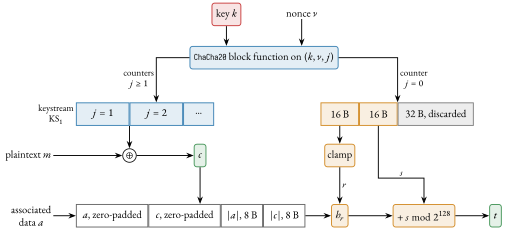
The scheme ChaCha20-Poly1305 (RFC 8439) is the AEAD by which Zcash encrypts every shielded note ciphertext and outgoing ciphertext (protocol specification, §“Symmetric Encryption”). It is an encrypt-then-MAC composition of the ChaCha20 stream cipher with the Poly1305 one-time MAC, in which the cipher derives both the keystream and the one-time MAC key from the single (k, ν) input.
Construction 6.18 (ChaCha20-Poly1305).
Fix a 256 -bit key k and a 96 -bit nonce ν . Encryption of a message m with associated data a proceeds as follows.
-
1.
One-time MAC key. Run ChaCha20 with key k , nonce ν , and block counter 0 ; take the first 32 bytes of the keystream block as the Poly1305 one-time key (r, s) —clamp the first 16 bytes to form r ; the next 16 are s . Discard the rest of this block.
-
2.
Encrypt. Run ChaCha20 with key k and nonce ν starting at block counter 1 , producing the keystream KS 1 (the keystream of Remark 6.3 taken from counter 1 onward), and set
c = m ⊕ KS 1 (k, ν, | m |) . -
3.
Authenticate. Form the Poly1305 input by concatenating: a padded with zeros to a 16 -byte boundary, c padded with zeros to a 16 -byte boundary, the 8 -byte little-endian length of a , and the 8 -byte little-endian length of c . Compute the tag
t = Poly1305 r, s (that input) .
The ciphertext is (c, t) . Decryption recomputes (r, s) and
the tag from (k, ν, a, c) , compares it to t in
constant time, returns ⊥ on mismatch, and otherwise
outputs
Figure 9 draws the dataflow of the construction.
Remark 6.19 (Length encoding prevents splicing).
Without the trailing 8 -byte lengths of a and c , the zero-padding that aligns a and c to 16 -byte boundaries would let an adversary shift bytes between the associated data and the ciphertext, or pad-extend one of them, while leaving the Poly1305 input string unchanged—breaking the binding between a and c even though every authenticated byte is intact. Appending the explicit lengths makes the MAC input an injective encoding of the pair (a, c) , the same injectivity that the per-block length encoding supplies within one message in the A Δ U analysis (Proposition 6.12).
Theorem 6.20 (Security of ChaCha20-Poly1305).
Model ChaCha20 as a pseudorandom function F k (ν, j)
from (nonce, block counter) pairs to 64 -byte blocks. In the
nonce-respecting model, ChaCha20-Poly1305 is a secure AEAD.
Concretely, consider a PPT adversary making q encryption queries
and q v verification queries, each of whose Poly1305
inputs—padded associated data, padded ciphertext, and the length
block—comprises at most l max sixteen-byte blocks,
| Adv F prf (B, λ) + 8 q v l max 2 106, |
where B is a PRF distinguisher of comparable cost.
Proof.
Sketch. Replace F k by a truly random function Φ from (nonce, counter) pairs to 64 -byte blocks. Any noticeable change in the adversary’s success probability yields a PRF distinguisher of comparable cost—it simulates the whole game using its function oracle—so each replacement costs one Adv F prf term; the CPA game is played twice (once per challenge bit), whence the factor two there. We analyse the idealised scheme.
Confidentiality. Since the adversary is nonce-respecting,
every encryption query uses a fresh ν , and the keystream blocks
Integrity. For each nonce ν , the block
Remark 6.21 (One key for encryption and authentication).
The scheme reuses one 256 -bit key for both encryption and
authentication, seemingly violating the independent-keys hypothesis
of Theorem 6.16. Reserving block counter 0 for
the Poly1305 key and counters
Remark 6.22 (Wrong-key rejection and key commitment).
Later volumes use this AEAD in a trial-decryption pattern: a
receiver detects the notes addressed to it by attempting decryption
of every ciphertext under each of its keys, relying on decryption
under a wrong key to return ⊥
(protocol specification,
§“Symmetric Encryption”). The
scheme provides this for honestly produced ciphertexts. Fix a
ciphertext
The guarantee does not extend to malicious senders: CPA security and
INT-CTXT are single-key notions, and nothing in
Definition 6.15 constrains a ciphertext crafted by
a sender who knows several keys. The scheme is not
key-committing—the separate notion demanding that no
ciphertext verify under two distinct keys—and a sender who chooses
keys
6.6 Key-derivation functions
Theorem 6.20 assumes a uniformly random 256 -bit key; its proof does not apply to a non-uniform key, whose structure the adversary may exploit. A Diffie–Hellman shared secret is high-entropy but not uniform: a structured group encoding, not a uniform bit string; a hardware noise source may likewise spread its unpredictability unevenly across its bits. A key-derivation function (KDF) converts such a source secret into one or more pseudorandom keys; the entropy of the source is measured worst-case, not average-case. (A passphrase is a usually low-entropy source and needs a deliberately costly password KDF instead.)
Definition 6.23 (Min-entropy).
The min-entropy of a random variable X is
| H ∞ (X) = − log 2 max x Pr [X = x] ; |
equivalently, the best chance of guessing X in one try is 2 − H ∞ (X) . Given side information Z , the conditional min-entropy is
| H ~ ∞ (X ∣ Z) = − log 2 E z ← Z max x Pr [X = x ∣ Z = z], |
so that 2 − H ~ ∞ (X ∣ Z) is the best chance of
guessing X from Z . Recall the statistical distance
Definition 6.24 (Key-derivation function and its security).
A key-derivation function is a function
| KDF : X × I × { 0, 1 } ∗ × N → { 0, 1 } ∗ |
taking a source secret (a sample of a random variable Σ over
X ), a non-secret salt
The notion a KDF targets is that of a seeded randomness extractor whose output need only be computationally indistinguishable from uniform.
Definition 6.25 (Strong computational extractor).
A keyed function
The leftover hash lemma realises the notion information-theoretically; the deployed mechanism below rests on random-oracle modelling instead.
Theorem 6.26 (Leftover hash lemma; stated without proof).
Let
| Δ ((R, g R (X)), (R, U n)) ≤ 1 2 2 n − γ . |
Thus
HKDF.
The standardised general-purpose KDF is Krawczyk’s HKDF (RFC 5869), built from HMAC (§5.3) in an extract-then-expand architecture: a salted HMAC call first distils suitable non-uniform input keying material into a short pseudorandom key (the extractor stage, justified along leftover-hash lines), and a counter-chained sequence of HMAC calls then expands that key, under a context string, up to RFC 5869’s limit of 255 hash-output-length blocks (the expander stage, justified by HMAC’s PRF security). The guarantee of HKDF depends on assumptions about the source and about HMAC. Zcash does not use it, because the protocol’s requirements are narrower and a single hash call meets them in the random-oracle analysis. The shielded protocol uses HMAC nowhere: neither the orchard nor the zcash_note_encryption crate carries an HMAC dependency (HMAC enters the wallet stack through the transparent BIP-32 derivation and BIP-39 mnemonic layers and, transitively, through the optional Tor client, never through a shielded crate).
The Zcash KDF.
Orchard derives the note-encryption key by one personalised BLAKE2b call:
| K enc = KDF (sharedSecret, epk) = BLAKE2b - 256 ("Zcash_OrchardKDF" ; sharedSecret ∥ epk), |
where sharedSecret is the Diffie–Hellman shared point of the note-encryption key agreement, epk is the sender’s ephemeral public key, and the quoted string occupies BLAKE2b’s 16 -byte personalisation field (the input is the serialised shared point followed by the ephemeral-key bytes, and the output is 32 bytes; protocol specification, §“Orchard Key Derivation”). The analysis models this personalised hash as a random oracle: by the domain-separation principle of §3.5 (Proposition 3.17, via the native-personalisation idiom catalogued there), the personalisation makes it an oracle independent of every other hash use in the protocol, and the derived key is uniform in the adversary’s view unless the adversary queries that oracle at the hidden sharedSecret —a query whose argument the adversary must first compute from the two public keys, an instance of the computational Diffie–Hellman problem of §2.2. Including epk in the input binds the derived key to this ephemeral key, the role the context string plays in HKDF. No salt is used because the claim is this narrower Diffie–Hellman-plus-random-oracle one—the unsalted premise of Definition 6.24—not extraction from every high-min-entropy source.